Krasper Bragi
An AI training platform that simulates customer conversations by voice, with a 3D avatar and calibrated scoring.

Core Capabilities
Characters that play real customers, from a caller with a broken heat pump to an escalation that starts angry. Archetypes and difficulty tiers are configured in the database, not written into the prompt by hand.
Personas answer from your own product information and troubleshooting steps. Knowledge groups are linked to scenarios and injected into the persona context at runtime, so the simulation matches the products your staff actually support.
A spoken conversation over WebSocket with voice activity detection. Deepgram, ElevenLabs and OpenAI Realtime are interchangeable as speech providers, with automatic failover between them.
An animated counterpart with lip sync, driven by NVIDIA Audio2Face-3D blendshapes generated from the audio stream, with emotion mapping from calm through confused to angry.
Every session is scored across dimensions such as empathy, problem solving and resolution effectiveness, against rubrics an administrator edits, clones and versions.
Reference conversations anchor the scoring. Regression runs check that a new prompt version still grades the same transcripts the same way, and calibration reports show inter-annotator agreement and trends.
Trainers claim an evaluation, then approve, revise or dismiss it, and promote strong conversations into the golden dataset. Every decision stays attributable.
Sequenced scenarios with a minimum score per step, assigned to individuals or teams, with progress tracked per step and assignments that can be paused and resumed.
XP, one hundred levels, badges, weekly, monthly and all-time leaderboards, and daily streaks, all derived from completed sessions rather than from self-reported activity.
A PDF certificate is issued on path completion, carrying an overall score and a certificate number, with a public verification page and an administrator revoke.
PII detection and redaction, prompt injection detection across seven categories, toxicity filtering and per-session token budgets, applied before and after every model call.
Performance overviews, trends, dimension analysis and common-issue tracking per team, under role-based access with 61 individual permissions and their own administration screen.
enterprise infrastructure?
Schedule a technical briefing. No sales pitch, just architects and your team.
Every conversation scored on the same dimensions
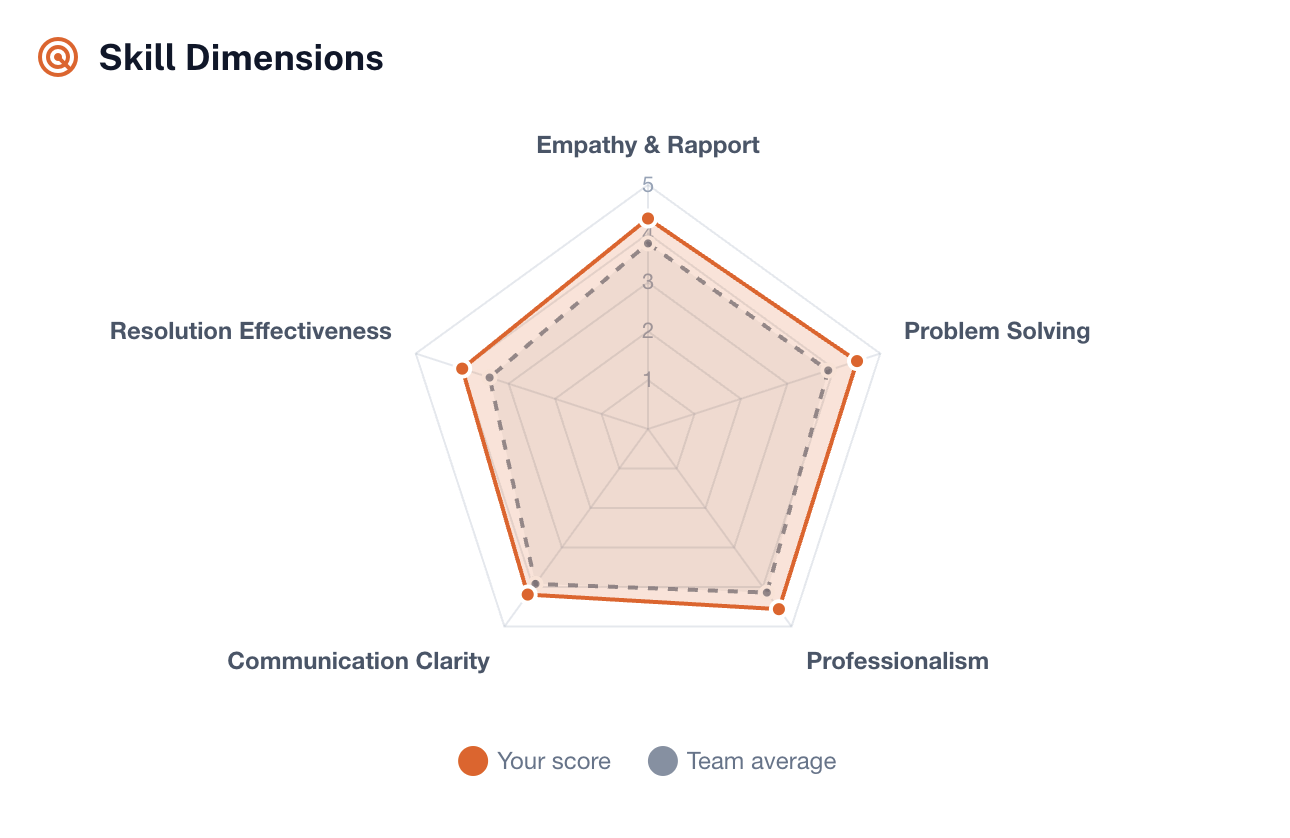
After a session the evaluation breaks the conversation into skill dimensions: empathy and rapport, problem solving, professionalism, communication clarity and resolution effectiveness. The trainee score sits against the team average, so a gap is visible before a manager has to put it into words.
Structured practice, not random roleplay
A path sequences scenarios and sets a minimum score for each step. A trainee advances when the step is passed, not when it is attempted.
A path in progress
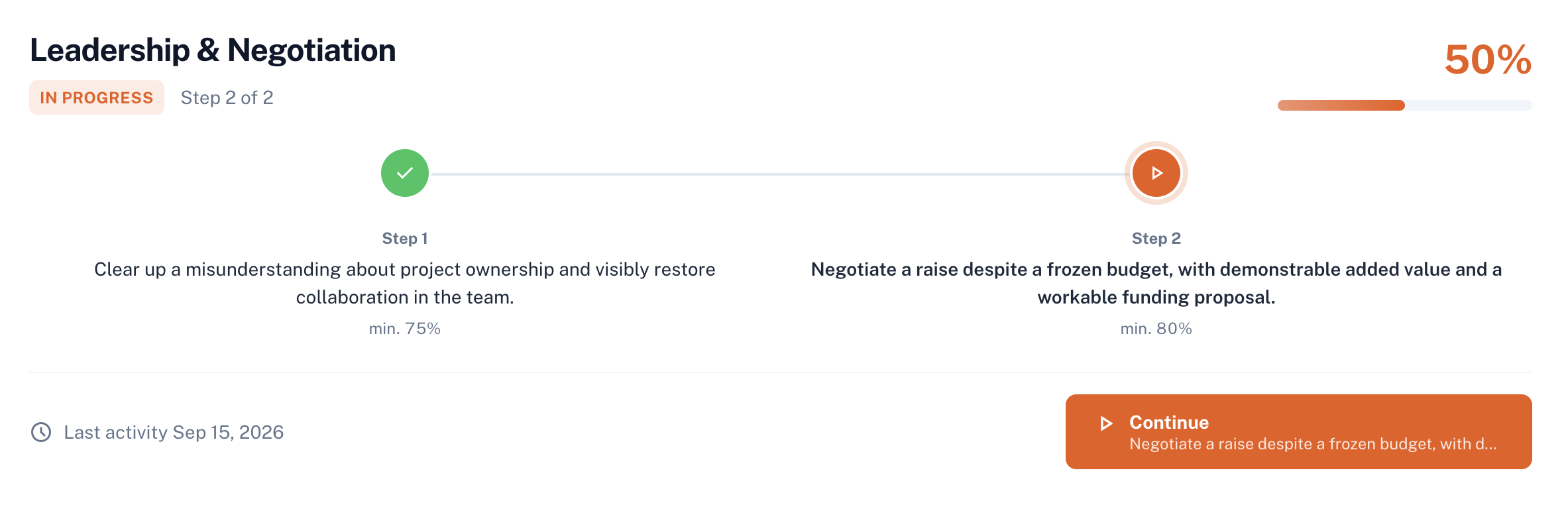
Leadership and negotiation, step two of two. The first step, clearing up a misunderstanding about project ownership and restoring collaboration, passes at 75 percent. The second, negotiating a raise against a frozen budget, requires 80 percent. Progress, last activity and the next step are one click apart.
Progress people can see
XP, levels, badges and leaderboards are computed from completed and scored sessions, so recognition follows practice rather than attendance.
Awards and what comes next
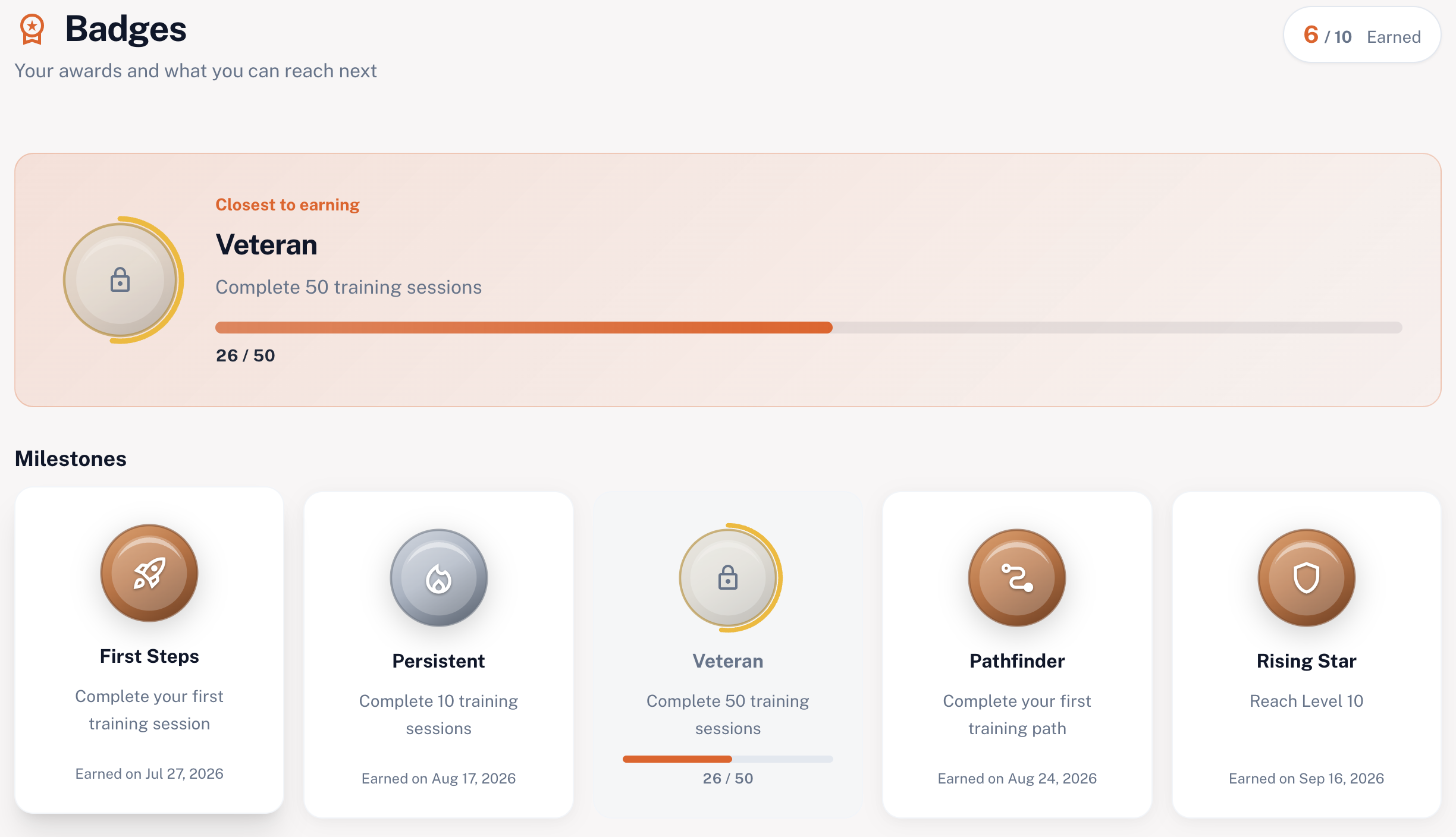
Milestone, streak, skill and special badges are awarded automatically. The closest unearned badge is surfaced with the distance still to run, here 26 of 50 training sessions towards Veteran.
A record that leaves the platform
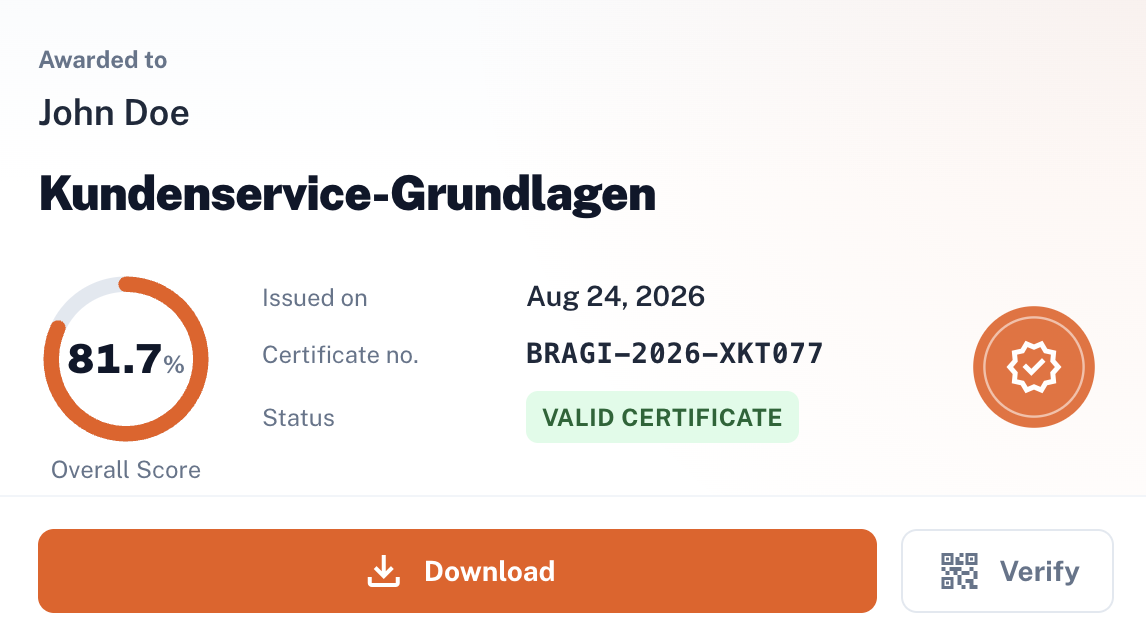
Completing a path issues a PDF certificate with an overall score, an issue date and a certificate number. The verification page is public, so the certificate can be checked by someone who has no account.
Your training data stays where you put it. Bragi runs self-hosted or as a managed service. Provider credentials are encrypted at rest, the guardrails detect and redact personal data before and after every model call, and local models through Ollama keep model traffic inside your own network. Retention periods, provider choice and deployment location are agreed during scoping.
Where conversation quality is the product
Support teams rehearsing escalations, complaints and handovers before they meet them on a live line.
Sales teams practising discovery, objection handling and negotiation against a customer who does not go easy on them.
Phone agents onboarded against a scenario catalogue, with a measured score before they take live traffic.
Technicians walking a caller through troubleshooting, on your own product documentation rather than a generic script.
Questions about Krasper Bragi
What is Krasper Bragi?
Krasper Bragi is an AI training platform for customer conversations. Employees speak with AI personas that behave like real customers, and every session is scored against a calibrated rubric, so practice produces a measurable result rather than an impression.
How does a training session work?
A trainee picks a scenario, or the next step of an assigned training path, and speaks with the persona in the browser. When the call ends the session is scored, with feedback per skill dimension against the team average, and the iOS app carries the same evaluations, paths and progress. Completing a path issues a certificate that carries a public verification page.
Does this replace human trainers?
No. It takes the roleplay partner out of the loop, so trainers spend their time in the review queue and on the cases the scoring flags, rather than acting out the twentieth call of the day.
How is the scoring kept consistent?
Rubrics are versioned, golden samples anchor the expected grade, and regression runs compare a new prompt version against those samples before it goes live. Disagreement between the scoring and human reviewers is reported as an agreement metric.
Can it run without sending data to an external provider?
Yes, with local models through Ollama on a self-hosted deployment. The speech providers are external by default, so a fully isolated voice setup is scoped separately.
Which languages does it support?
The platform ships in German and English throughout, including evaluation feedback and certificates.