Krasper Raigate
An AI governance firewall with real-time context detection, running entirely on your own hardware.
Core Capabilities
Define deterministic allow/block/approve rules across every AI interaction. Policies are version-controlled, auditable, and enforced at runtime, not as a suggestion layer.
Automatically detect and redact personally identifiable information from prompts and completions before they leave your governed perimeter, across text, structured data, and documents.
Block adversarial prompt injections, jailbreak attempts, and indirect injection vectors in real time, before they reach your model or exfiltrate data from your agents.
Every governed request, whether blocked, approved, or redacted, is logged to the database. Filtered or blocked actions are documented securely, for auditors, regulators, and your CISO.
Route sensitive AI actions to a human reviewer before execution. Define escalation paths, approval SLAs, and reviewer roles, with full traceability of every decision.
Pre-built control mappings for EU AI Act, ISO 42001, and NIST AI RMF. Generate evidence exports and auditor workspaces ready for regulatory submissions.
Intercept and govern AI usage directly inside browser sessions, including ChatGPT, Gemini, Claude, and Microsoft Copilot. In-flight typed-input redaction means sensitive data never reaches the model.
Govern agentic AI workflows and MCP tool-call surfaces. Define server allow/block policies, require approval receipts before tool execution, and maintain full traceability.
One control plane across OpenAI, Anthropic, Gemini, Microsoft Copilot, and custom model APIs, plus browser-session interception. No blind spots.
Package policy coverage reports, blocked/approved interaction traces, and redaction hit rates into structured, regulator-ready evidence bundles at the click of a button.
Real-time dashboards for policy hit rates, blocked interactions, PII exposure events, and model risk posture.
enterprise infrastructure?
Schedule a technical briefing. No sales pitch, just architects and your team.
Building a policy rule, step by step
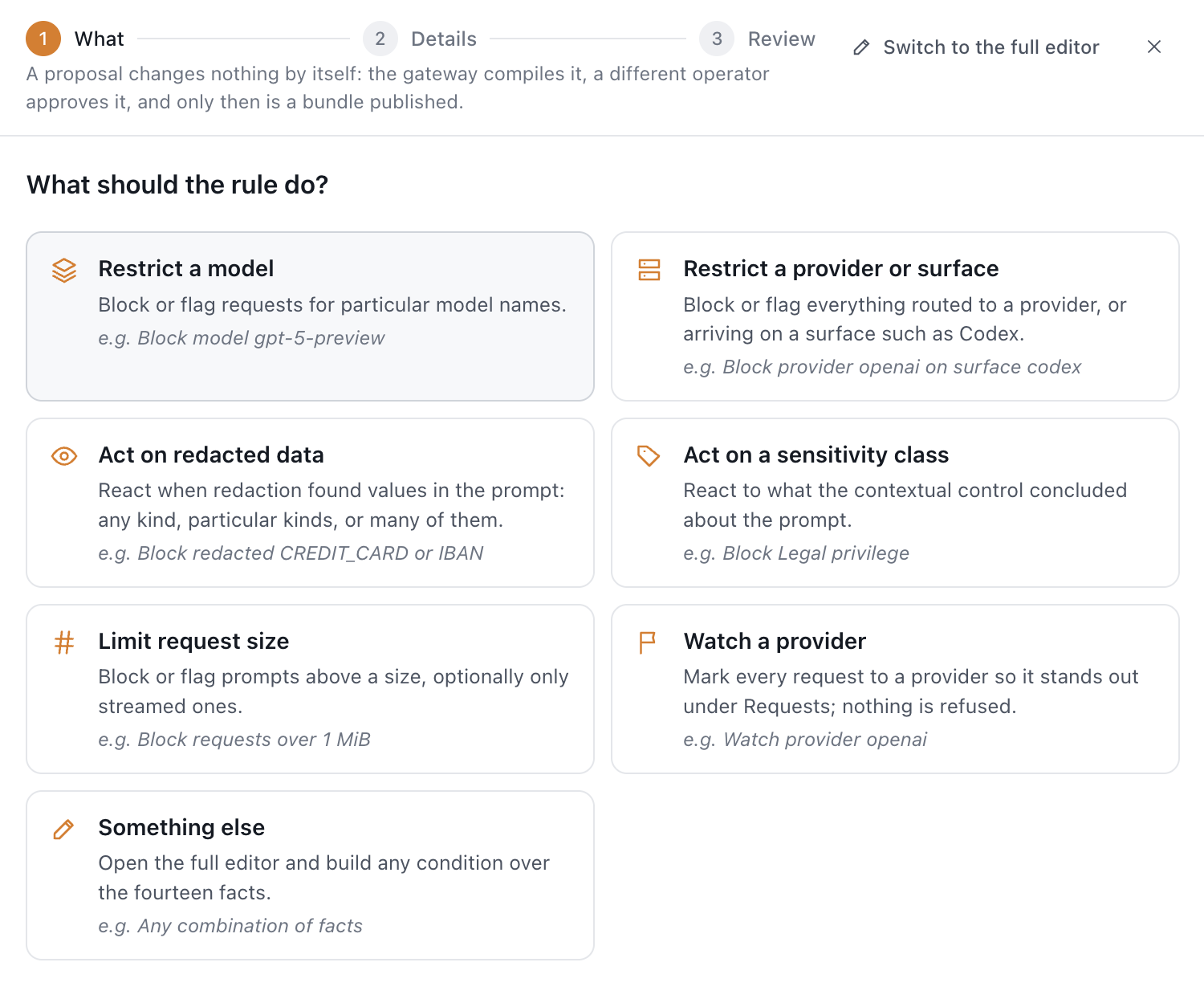
The rule wizard walks an operator through what a policy should do: restrict a model, restrict a provider or surface, act on redacted data, act on a sensitivity class, limit request size, watch a provider, or something else. A proposal changes nothing by itself: the gateway compiles it, a different operator approves it, and only then is a bundle published.
One Platform. Three Control Layers.
Competitors like Palo Alto AIRS, LayerX, and Cloudflare each cover a piece of this. Raigate ships it as a single, self-hosted firewall.
Transparent proxy across OpenAI, Anthropic, Gemini, Microsoft Copilot, and custom upstreams. Every API call intercepted, policy-evaluated, and logged.
In-flight interception of ChatGPT, Gemini, Claude, and Microsoft Copilot web sessions, including typed-input redaction before the prompt is submitted.
Tool-call governance and MCP server policy for agentic workflows. Approval receipts, server allow/block rules, and full audit traceability.
Your control plane runs inside your perimeter. Raigate is self-hosted. If you allow an external AI provider, permitted requests are forwarded to that provider after the configured policy checks and redaction. Fully isolated deployments require local models and integrations. Deployment location, outbound access and evidence retention are agreed during scoping.
Every governed request, logged in real time
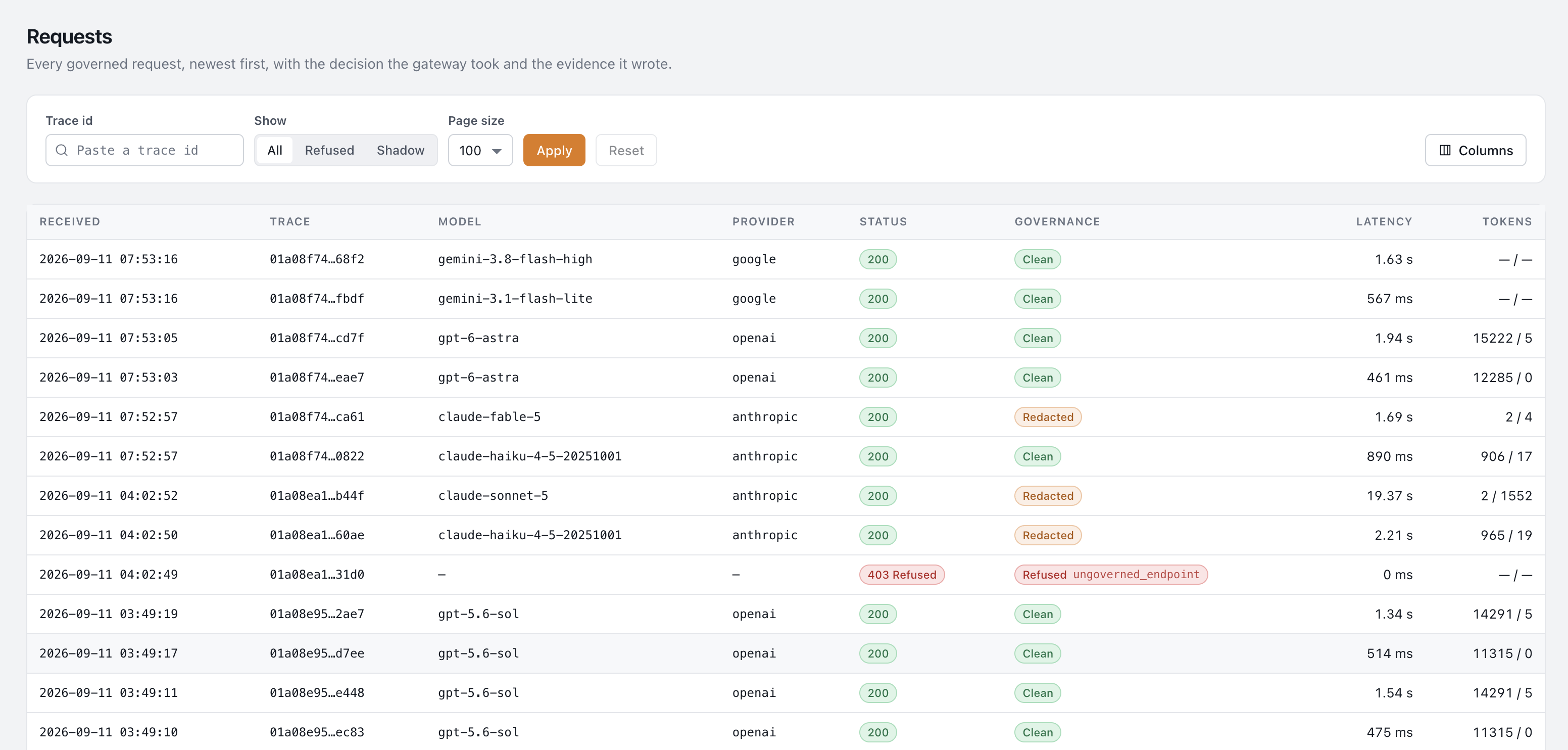
The requests view lists governed traffic as it happens: received time, trace ID, model, provider, HTTP status, governance outcome, such as clean, redacted, or a refused call blocked for hitting an ungoverned endpoint, latency, and token counts. Providers shown here are Google, OpenAI, and Anthropic, the same surfaces the policy engine governs above.
Browser and SaaS Shadow-AI Control
Staff already use ChatGPT, Gemini, Claude, and Microsoft Copilot in the browser, whether IT has sanctioned it or not. Raigate applies the same policy to that traffic as it does to API calls.
The same allow/block/approve policy that governs API traffic applies inside the browser session for ChatGPT, Gemini, Claude, and Microsoft Copilot: typed input is redacted, or the interaction is blocked outright, before the prompt reaches the model. Runtime dashboards then show the same telemetry as any other governed surface: policy hit rates, blocked interactions, and PII exposure events.
Agent and MCP Governance
The same policy engine covers agentic workflows and MCP tool-call surfaces: server allow/block rules, approval receipts required before a tool executes, and full traceability of every decision, whether blocked, approved, or escalated to a human reviewer.
Verifying the audit chain, on demand
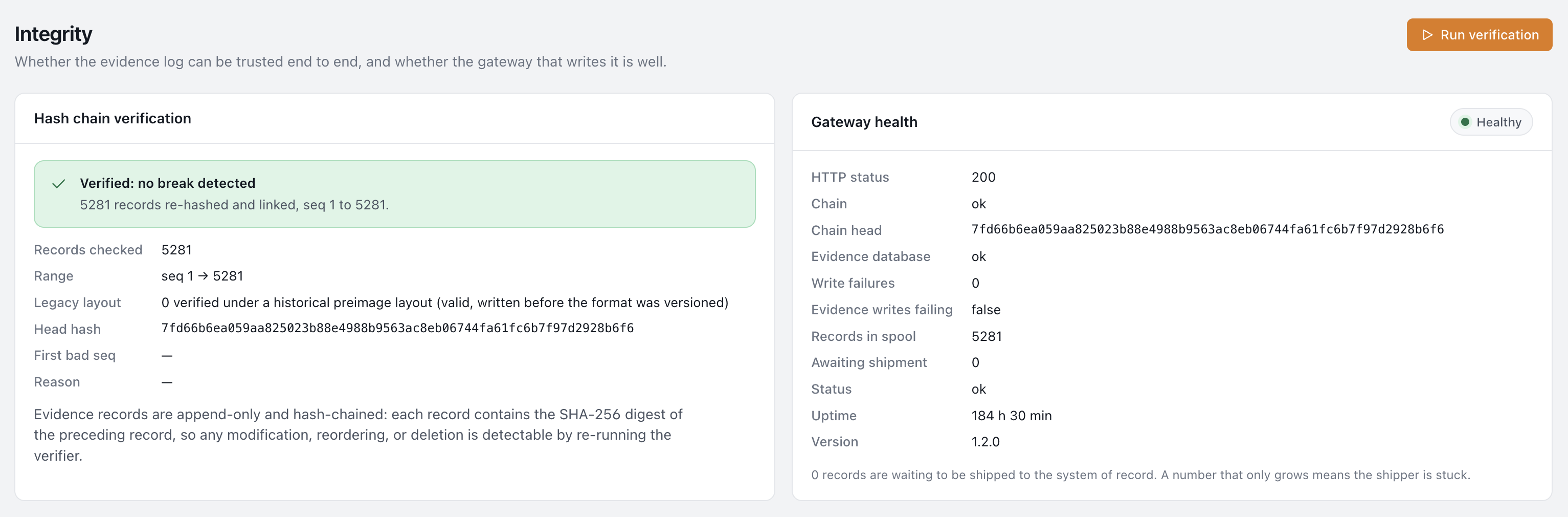
The integrity view re-verifies the audit chain on demand: each record is append-only and carries the SHA-256 digest of the one before it, so the verifier can confirm whether the chain still holds, or point to exactly where a later edit, reorder, or deletion broke it. A gateway health panel runs alongside it.
Market Validation: The Category Is Now Mainstream
Selected acquisitions, product announcements and funding rounds in AI runtime security, 2025–2026. These events describe market activity, not independent validation of Raigate.
Runtime AI security + prompt controls folded into a major EDR platform.
Runtime guardrails and GenAI red teaming integrated into Check Point's enterprise security stack.
Major platform update with agent-platform integrations (Factory, Glean, IBM, ServiceNow).
Cisco broadens AI Defense portfolio covering both AI usage and development protection.
Browser security acquisition, confirming prompt-time browser interception is a strategic battleground.
Institutional validation that the market supports large independent companies.
The core primitives (proxying, DLP, policy gating, audit logging) exist across these platforms. Raigate is differentiated by integration: API proxy + browser-session interception + agent/MCP governance + deterministic policy + self-hosted control plane as a single product. Most competitors require two or three platforms to approximate the same coverage.
Pricing: Built Around Your Scale
Priced by scope, not by seat: governed request volume per month, and the feature tier your deployment needs, policy enforcement and audit logging at Growth, the full approval-workflow and compliance-pack suite at Business, dedicated engineering support and custom SLAs at Enterprise. Every plan runs on your own infrastructure; a DPA is included.
See your own number, not a list. Use the ROI calculator above for an estimate tailored to your industry, size, and AI usage. We confirm the exact figure during a 30-minute discovery call.
- 10M governed requests / month
- Policy enforcement + PII redaction
- Audit logging to the database
- Overage billed per 1,000 requests
- Ideal for enterprise mid-market teams
- 75M governed requests / month
- Full policy suite + approval workflows
- Multi-model & multi-cloud governance
- EU AI Act / ISO 42001 compliance pack
- Overage billed per 1,000 requests
- Unlimited governed requests
- Dedicated engineering support for your deployment
- Advanced evidence export & auditor workspace
- Custom SLA + priority engineering support
- Volume-based pricing
Paid Pilot: Deploy Governance in Hours, Not Weeks
Setup runs in about four hours, often minutes for simpler environments. Success criteria defined upfront. No open-ended engagements.
Deliverables: Policy coverage report · PII redaction hit rate · Blocked/approved trace evidence · Audit export completeness. Credited toward annual contract.
Krasper Raigate: Common Questions
What does Raigate run on?
Raigate runs as a container on your own hardware, on-premise, in your private cloud, or fully air-gapped. It is sized to your traffic rather than a fixed spec sheet, and you operate the deployment: Krasper retains no access unless you ask us to.
How does Raigate govern ChatGPT, Gemini, Claude, and Copilot in the browser?
The same allow/block/approve policy that governs API traffic applies inside the browser session for ChatGPT, Gemini, Claude, and Microsoft Copilot: typed input is redacted, or the interaction is blocked outright, before the prompt reaches the model.
What does a Raigate evidence bundle contain?
Policy coverage reports, blocked and approved interaction traces, and redaction hit rates, packaged into a structured, regulator-ready bundle at the click of a button, the same evidence auditors, regulators, and your CISO ask for.
Does Raigate maintain an AI system or asset registry?
Not in the current release. Raigate inspects, filters, and blocks AI traffic against your policy; a system or asset registry is planned for a future version.
What does Raigate cost?
Three tiers, Growth, Business, and Enterprise, are priced on request rather than listed, because the price is set by governed request volume and by feature tier, not by seat. As a rough guide, the ROI calculator above prices a self-hosted deployment from around $30,000 a year for small teams up to $240,000 a year at 1,000+ employees; book a briefing for the exact figure.
What does an AI breach cost vs. Raigate?
Choose three inputs for an illustrative risk and deployment-cost estimate. Assumptions are planning inputs, not measured outcomes or a binding quote.
Full report sent to your inbox
Raigate cost range and projected savings are in the report we just emailed you. Check your inbox, the message arrives within a minute.