Automation
You send invoices, contracts or forms. You get structured records in the system you already use, with a confidence score on each field and a human queue for everything the model will not commit to.
Retrieval assistants answer from your own files and cite the page each sentence came from. Workflow agents run multi-step processes that used to need a person watching them. Both run on your infrastructure or ours, and both keep a record of what they did.
In: PDF, DOCX or a mailbox. Out: records in your system. Typical first delivery: two to four weeks.
Two pipelines, drawn the way they run
Both are working examples from our own house, not diagrams made for a brochure. Every step is a node you can open, every branch is named, and the failure path is wired rather than assumed.
Contact form to CRM
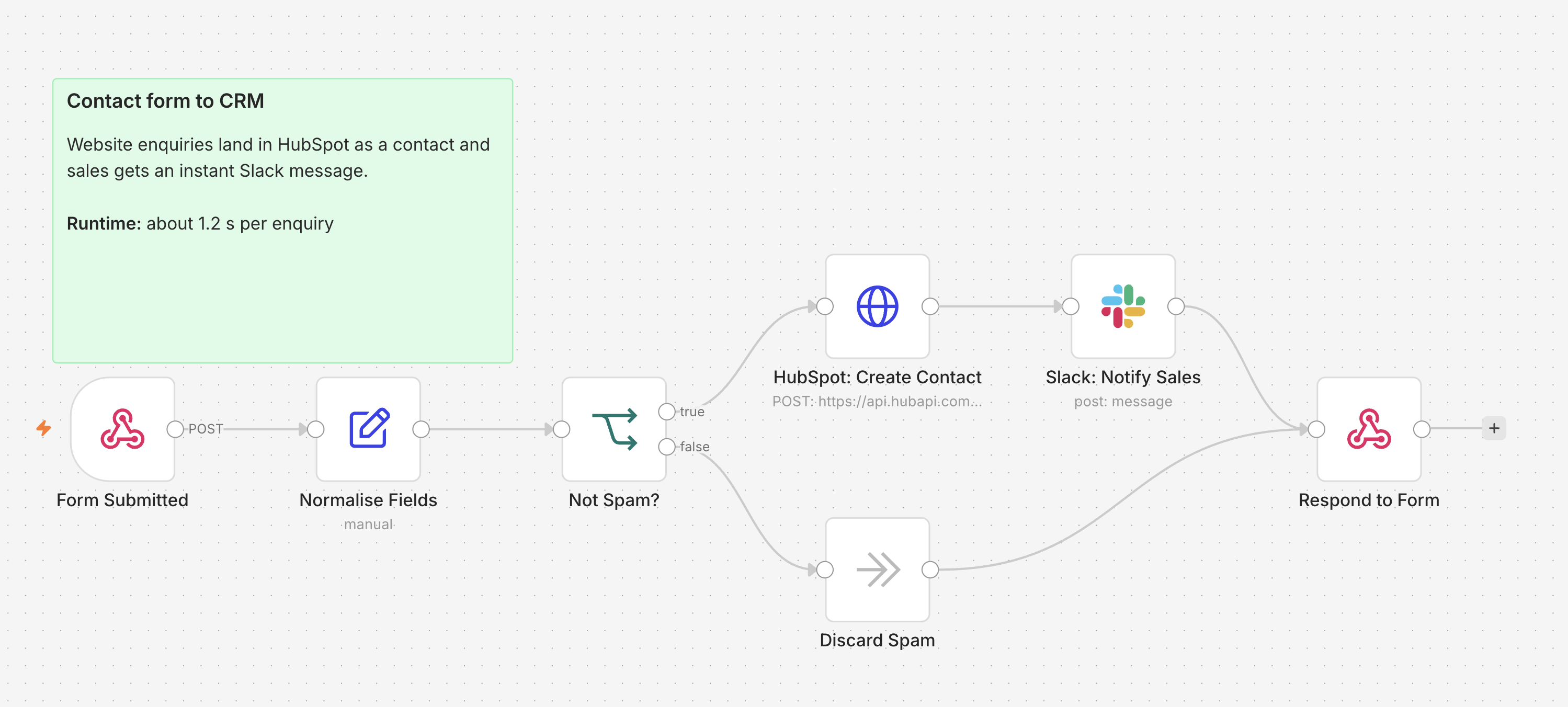
The small end. An enquiry arrives on a webhook, the fields are normalised, one check decides the branch: a real enquiry becomes a CRM contact and a message to the sales channel, spam is dropped, and either way the form gets its answer. About 1.2 seconds per enquiry, and nobody retypes an address.
Enquiry routing and quote
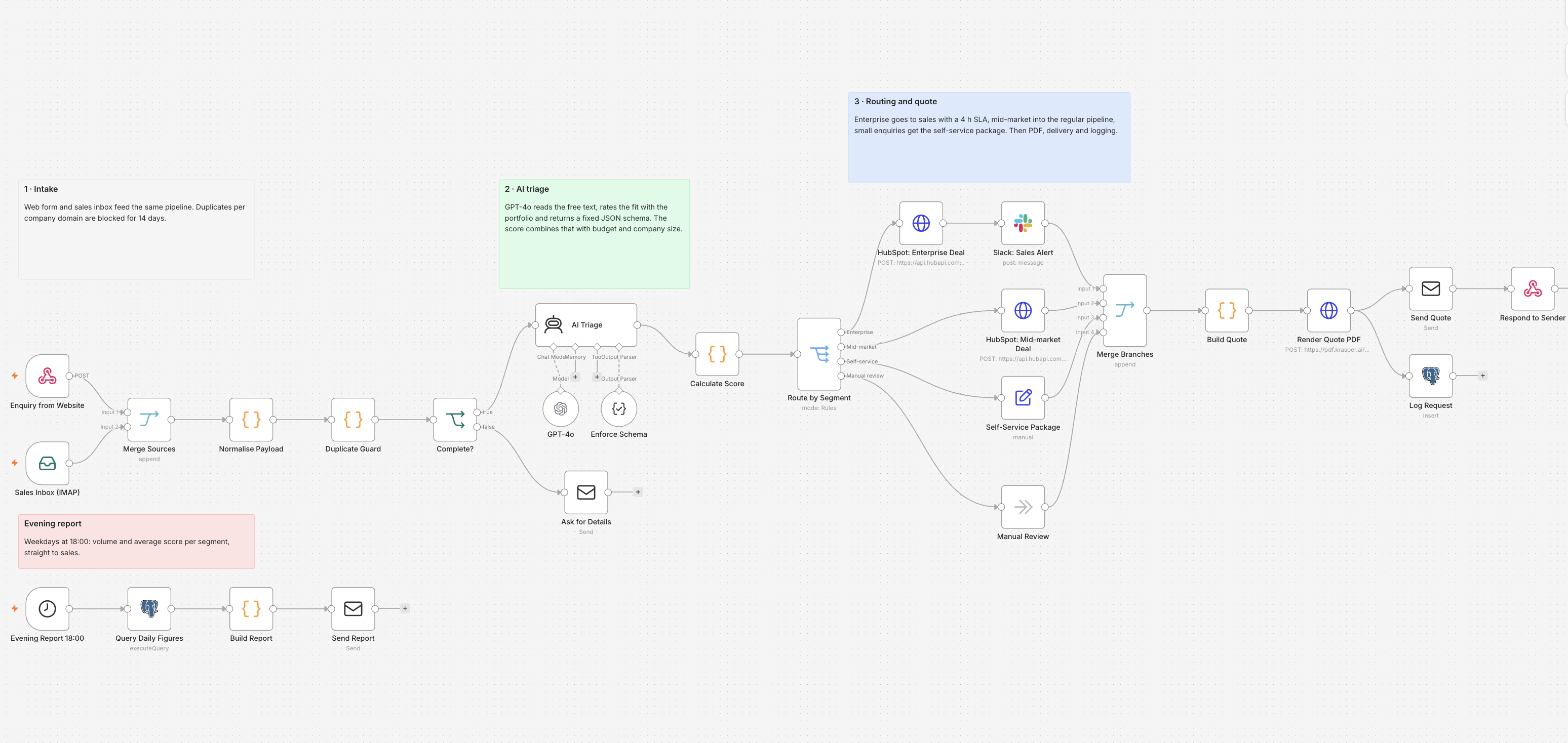
The same shape at working size. A web form and the sales inbox feed one intake, repeat senders from a company domain are held for fourteen days, a language model reads the free text and returns a fixed schema, and the score routes the enquiry to sales, to the regular pipeline, to a self-service package or to a person. The quote PDF and the evening figures are the same run.
enterprise infrastructure?
Schedule a technical briefing. No sales pitch, just architects and your team.
A pipeline that grows is the normal case: the first one is usually the small one above, and the second is what it looks like a few months later. Both run on your infrastructure or ours, and both keep a record of what they did — which branch fired, what was sent, and what came back.